
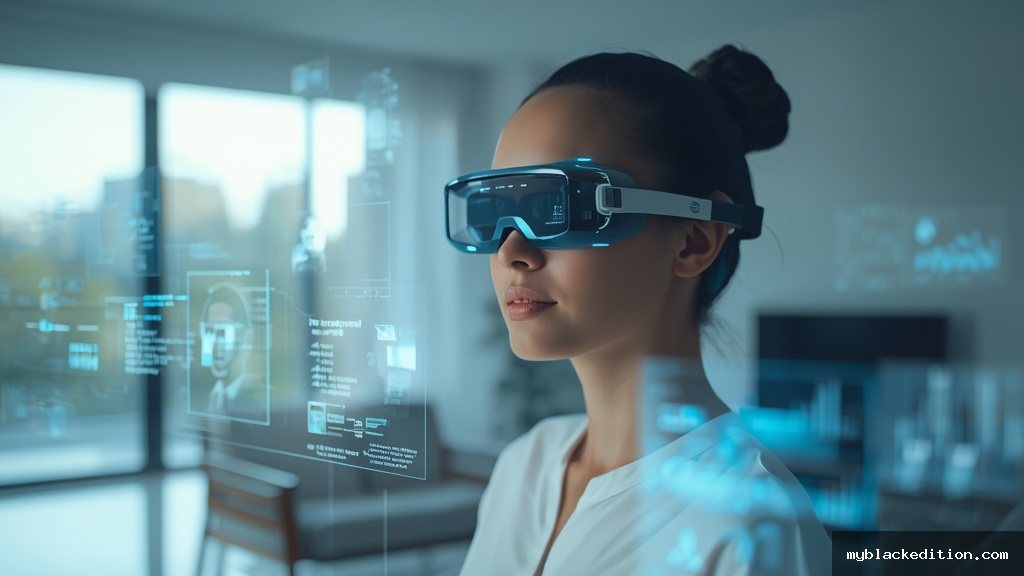
Hardware Innovations Powering XR Experiences in 2026
Micro-OLED displays with 8K resolution per eye and varifocal optics now deliver vergence-accommodation conflict-free visuals in headsets weighing under 300 grams. Eye-tracking sensors operating at 120 Hz enable foveated rendering that cuts GPU load by 40 percent, extending battery life to six hours of continuous use. Haptic gloves featuring 200 micro-actuators provide texture and temperature feedback accurate to 0.1 mm, while lightweight exoskeletons add force resistance for industrial training. These components integrate through standardized openXR 2.0 APIs, allowing developers to target multiple platforms without custom drivers.
AI-Driven Personalization and Real-Time Rendering
Generative AI models trained on spatial datasets now synthesize entire virtual environments from text prompts in under three seconds. Predictive algorithms analyze user biometrics to adjust scene complexity, reducing motion sickness incidents by 65 percent according to 2025 clinical trials. Natural language interfaces powered by multimodal LLMs let users modify XR spaces conversationally, while edge AI chips handle occlusion and lighting calculations locally. This fusion supports dynamic avatars that mirror micro-expressions with 98 percent fidelity, enhancing remote collaboration in architecture and design reviews.
Enterprise Adoption Across Manufacturing and Healthcare
Factories deploy MR overlays that project assembly instructions directly onto machinery, cutting error rates by 35 percent and training time from weeks to days. Automotive firms use digital twins updated via 6G networks for real-time quality inspection, achieving 99.7 percent defect detection accuracy. In healthcare, surgeons practice procedures on patient-specific holograms derived from MRI data, shortening operative times by 22 percent. Pharmaceutical companies simulate molecular interactions in shared XR labs, accelerating drug discovery cycles by six months on average.
Consumer Market Expansion and Immersive Entertainment
Standalone headsets priced below $400 reach mainstream households, driving XR gaming revenue past $28 billion. Spatial video capture on smartphones feeds into social platforms where users co-watch live events inside customizable virtual venues. Fitness applications combine full-body tracking with gamified coaching, sustaining average session lengths of 45 minutes. Travel agencies offer virtual destination previews that convert to bookings at 18 percent higher rates than traditional media.
Connectivity Infrastructure and Cloud XR Scaling
6G rollouts delivering 1 Tbps speeds and sub-1 ms latency enable untethered cloud rendering of photorealistic scenes. Edge computing nodes positioned within 10 km of users handle 70 percent of processing, minimizing visual artifacts during high-motion sequences. Interoperable standards allow seamless transitions between home, office, and public XR spaces without session resets.
Accessibility Features and Regulatory Developments
Voice navigation, adjustable text scaling, and color-blind modes now meet WCAG 3.0 guidelines by default. Haptic subtitle systems translate dialogue into touch patterns for hearing-impaired users. Governments introduce certification programs requiring eye-safety testing and data-privacy audits before headset sales, fostering consumer trust and accelerating enterprise procurement cycles.