Cape Peninsula University of Technology: Courses, Admissions, and Campus Life Guide
Cape Peninsula University of Technology (CPUT) stands as one of South Africa’s leading institutions of higher learning, embracing a strong focus on applied research, innovation, and industry-relevant education. Established in 2005 through the merger of Cape Technikon and Peninsula Technikon, CPUT has become the largest university of technology in the Western Cape. Its vibrant campuses attract students locally and globally, offering diverse academic programs aligned with modern economic and technological demands.
Course Offerings and Faculties
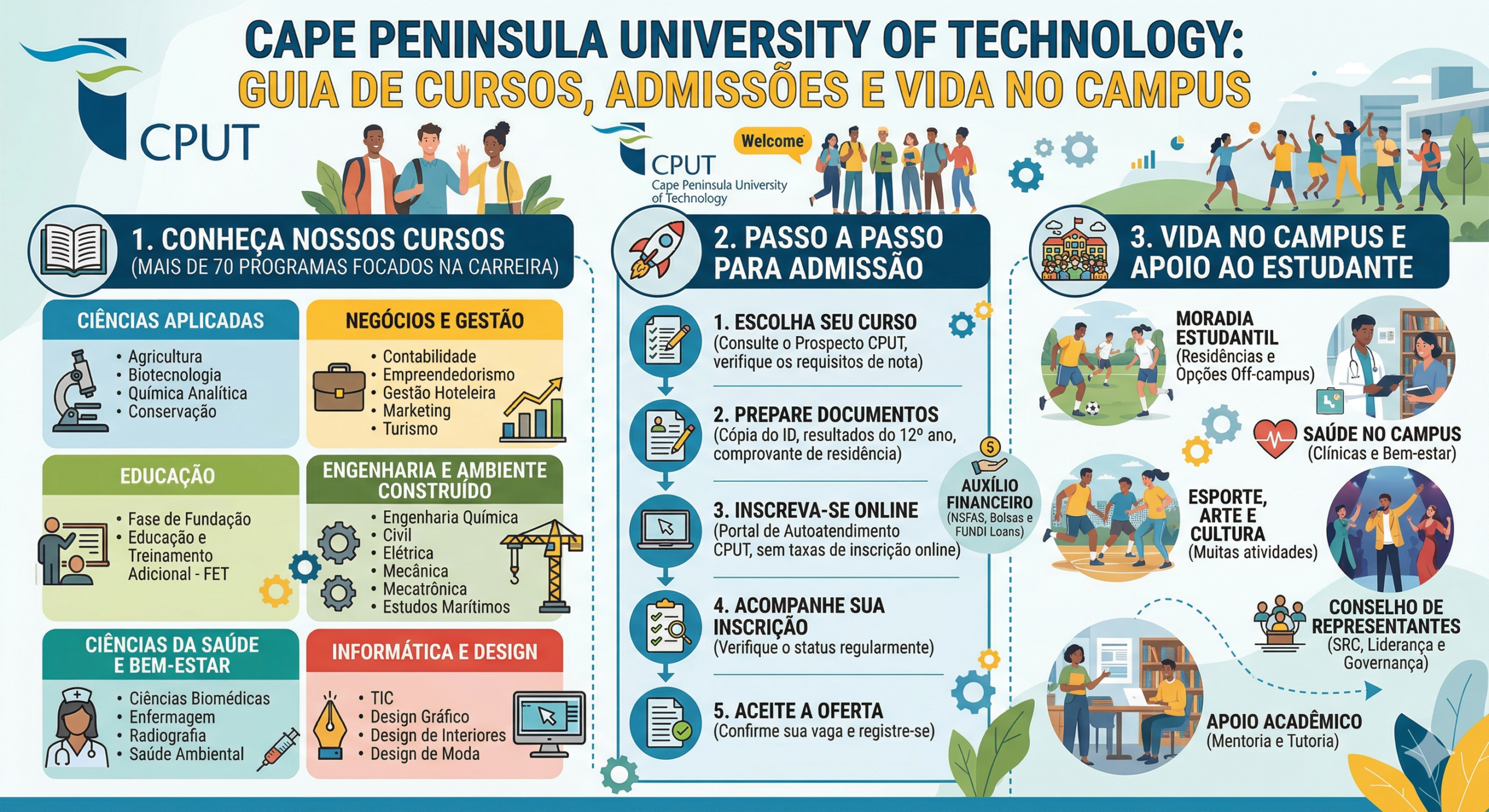
CPUT offers a comprehensive selection of undergraduate and postgraduate qualifications, spanning diploma, degree, and doctoral levels. The university is organized into six main faculties: Applied Sciences, Business and Management Sciences, Education, Engineering and the Built Environment, Health and Wellness Sciences, and Informatics and Design. Each faculty integrates theory with practical training, ensuring graduates are workplace-ready.
The Faculty of Engineering and the Built Environment remains one of CPUT’s most sought-after divisions, offering programs in civil, electrical, mechanical, chemical, and marine engineering. The curriculum incorporates cutting-edge laboratory work, industrial placements, and research projects that align with South Africa’s infrastructure development goals. Similarly, the Faculty of Applied Sciences covers key areas such as biotechnology, environmental health, horticulture, and analytical chemistry, emphasizing sustainability and innovation.
For students interested in business disciplines, the Faculty of Business and Management Sciences offers programs in marketing, human resources, accountancy, and entrepreneurship. These courses develop skills relevant to both corporate and entrepreneurial contexts, fostering leadership and analytical thinking. The Faculty of Informatics and Design encourages creativity and technology integration, offering degrees in graphic design, information technology, architecture, and multimedia studies. CPUT’s Education faculty prioritizes teacher training that addresses diverse learning environments, while Health and Wellness Sciences prepares professionals in nursing, radiography, biomedical technology, and emergency medical care.
Admission Requirements and Application Process
Admission to CPUT is competitive, emphasizing both academic merit and program-specific qualifications. Applicants must meet the National Senior Certificate (NSC) requirements, with appropriate endorsement for diploma or degree studies. Each faculty sets particular minimum subject criteria and admission point scores (APS) that vary based on the chosen program. For example, engineering entrants require strong mathematics and physical sciences results, while design students may need to submit portfolios showcasing creative work.
Prospective students apply online through the CPUT admissions portal. The process involves selecting a program, completing the application form, attaching certified copies of academic transcripts, identification, and supporting documents, and paying a non-refundable application fee. International students must provide proof of English language proficiency, passport copies, and, once accepted, a valid study visa. CPUT also accommodates Recognition of Prior Learning (RPL), allowing candidates with substantial work experience but limited formal qualifications to gain access to specific programs.
The university issues provisional acceptance letters to qualifying candidates, followed by detailed registration instructions. Materials outlining residence options, tuition fees, and orientation schedules accompany final admission notices. Early applications are encouraged, as popular courses fill quickly and limited-campus residence space is allocated on a first-come, first-served basis.
Funding and Financial Assistance
CPUT supports students through multiple financial aid channels. The National Student Financial Aid Scheme (NSFAS) provides bursaries covering tuition, accommodation, and learning materials for eligible South African students. Additionally, various merit-based and faculty-specific scholarships reward academic excellence, leadership, or community service. Postgraduate bursaries, including research fellowships, are available through partnerships with government institutions and private sponsors. The Financial Aid Office offers guidance on budgeting, loan options, and application timelines.
Campus Locations and Facilities
CPUT operates across multiple campuses, strategically located in and around Cape Town. The main campuses—Bellville and Cape Town—anchor most faculties and administrative divisions. Other campuses include Mowbray, Granger Bay, Wellington, and Tygerberg, each specializing in particular disciplines. Bellville campus is known for engineering and business programs, while the Cape Town campus, nestled in the city center, hosts design and IT departments. Granger Bay, overlooking Table Bay, houses the Maritime Studies and Hotel School, providing an ideal learning environment for ocean economy and hospitality students.
Campus facilities reflect the university’s commitment to hands-on learning. State-of-the-art laboratories, technology-rich classrooms, multimedia centers, and extensive libraries support academic excellence. Research units, including the Centre for Water and Sanitation Research and the Energy Institute, promote innovation addressing regional and global challenges. High-speed Wi-Fi access, computer labs, and digital learning platforms ensure that students remain connected in a technology-driven environment.
Student Life, Residences, and Extracurricular Activities
Beyond academics, student life at CPUT is dynamic and inclusive. The institution encourages participation in sports, cultural societies, and volunteer initiatives through the Student Affairs Department. Sports such as soccer, netball, athletics, and rugby foster teamwork and school spirit, while cultural associations celebrate South Africa’s diversity through events and creative performances. Regular career fairs, entrepreneurship workshops, and leadership programs support personal development and employability.
Accommodation is available both on and off campus, with several well-maintained residences offering furnished rooms, communal kitchens, and study areas. Residence managers and wardens assist students with integration and support services. CPUT ensures a safe living environment through 24-hour security, access control, and medical support facilities. Students who prefer private housing can find numerous apartments and hostels near campuses, with the institution offering guidance on tenancy agreements and rental safety.
International and Exchange Opportunities
CPUT maintains strong international partnerships, enabling academic exchange and collaborative research. Students benefit from study-abroad programs, joint degrees, and internships with partner institutions across Africa, Europe, and Asia. The International Office assists in visa applications, orientation, and cultural adaptation. These global opportunities enhance academic exposure and build transnational networks vital for professional growth.
Support Services and Career Development
Comprehensive student support systems underpin CPUT’s educational mission. The Centre for Student Counselling provides mental health assistance, career guidance, and personal development workshops. Academic literacy units offer tutoring, writing centers, and e-learning support to enhance academic performance. The Disability Unit ensures inclusion by supplying adaptive technology and personalized assistance to students with special needs. Career development offices connect graduates to employers through industrial placements, mentorship programs, and alumni networks, preparing them to transition confidently into the professional sphere.
Research and Innovation Culture
As a recognized leader among universities of technology, CPUT emphasizes applied research solving real-world challenges. Research chairs focus on renewable energy, food security, engineering innovation, and health sciences. Collaboration with government agencies and private industries ensures that findings translate into practical applications. Students at postgraduate level often participate in these projects, gaining invaluable exposure to advanced research methodologies, innovation management, and entrepreneurship.
Community Engagement and Sustainability
Social responsibility forms an integral part of CPUT’s vision. Through community outreach projects and sustainability initiatives, students and staff contribute to urban renewal, environmental conservation, and educational upliftment programs. Waste reduction campaigns, renewable energy installations, and community health clinics illustrate CPUT’s dedication to responsible citizenship and long-term ecological balance.